


You could have the best-built garden rooms in the county, a genuinely well-structured website, and still lose the click to a competitor sitting just below you on Google, purely because their title tag gives Google and the searcher a clearer reason to choose them. It sounds like a small detail. It isn’t. Title tags and meta descriptions are two of the most influential, and most commonly botched, elements on a garden room installer’s website.
Why the Title Tag Matters So Much
Your title tag is the blue, clickable headline that shows up on the Google search results page, and it does two jobs at once. It’s one of the strongest on-page ranking signals Google uses to understand exactly what a page is about, and it’s also the very first thing a potential customer reads before deciding whether to click through to your site at all.
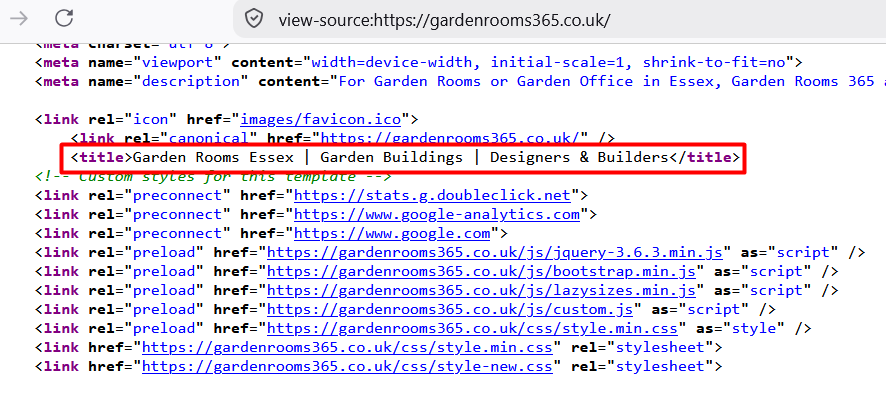
Get it wrong, and you’re fighting an uphill battle on both fronts. A vague title like “Home | ABC Garden Rooms” tells Google almost nothing about what the page actually covers, and it gives a searcher no reason to pick you over the three other results sitting above and below you. A properly written title tag, by contrast, directly reflects the exact search someone typed in, which both helps you rank for it and makes you the obvious click once you’re there.
Your Homepage: Target the Main Town and County Together
For most garden room installers, the homepage should be built around your primary town alongside your wider county, since this is usually your highest-volume, most competitive search term. If you’re based in Chelmsford and cover the whole of Essex, a title like:
“Garden Rooms Chelmsford & Essex | [Your Company Name]”
does exactly what it needs to. It’s specific, it includes both the town and the county in a natural way, and it immediately tells anyone searching either term that they’ve landed in the right place. Compare that to something generic like “Welcome to Our Website,” which gives Google nothing to work with and gives a searcher no confidence they’ve found a local specialist at all.
This single page usually carries the most authority on your entire site, so it’s worth getting the title exactly right, since it’s likely to be your strongest shot at ranking for your broadest, highest-value search term.
Local Service Pages: Keyword Plus Town
Once you move beyond the homepage into your individual town pages, the formula shifts slightly. Rather than combining town and county together, each local page should target its specific town on its own, paired directly with your core keyword. So for a page built for Billericay, the title should read something close to:
“Garden Rooms Billericay | Bespoke Garden Room Installers”
Notice the structure: the keyword “garden rooms” comes first, immediately followed by the town name. This mirrors almost exactly how someone actually searches, “garden rooms Billericay,” rather than “Billericay garden rooms,” and matching that natural search order in your title tag reinforces relevance for that specific query.
Example:
homepage – https://gardenrooms365.co.uk
location page – https://gardenrooms365.co.uk/garden-rooms-billericay
Repeat this same structure for every town page you build, garden rooms Brentwood, garden rooms Basildon, garden rooms Southend, each with its own dedicated title following the same pattern.
Service Pages: Keyword Plus Room Type, Plus Area
Your service pages, covering the different types of garden room you install, need their own version of this same logic. Rather than town names, these pages pair your core keyword with the specific type of garden room, and ideally still reference your broader area for local relevance. For a garden gym page, that might look like:
“Garden Gym Rooms Essex | Bespoke Home Gym Installations”
or for a garden office page:
“Garden Office Rooms Essex | Insulated Garden Offices Built to Last”
The pattern stays consistent throughout: room type first, since that’s the specific product someone’s searching for, followed by your county for local relevance. This keeps every service page targeting its own distinct keyword rather than all of them competing against each other for the same generic terms.
Meta Descriptions: The Sales Pitch Underneath the Title
While the title tag has the bigger direct impact on rankings, the meta description sitting just underneath it on the search results page is where you actually sell the click. Google doesn’t always use your exact meta description, sometimes it pulls a different snippet if it thinks another part of the page answers the search better, but when it does use yours, it’s valuable space that shouldn’t be wasted on generic filler.
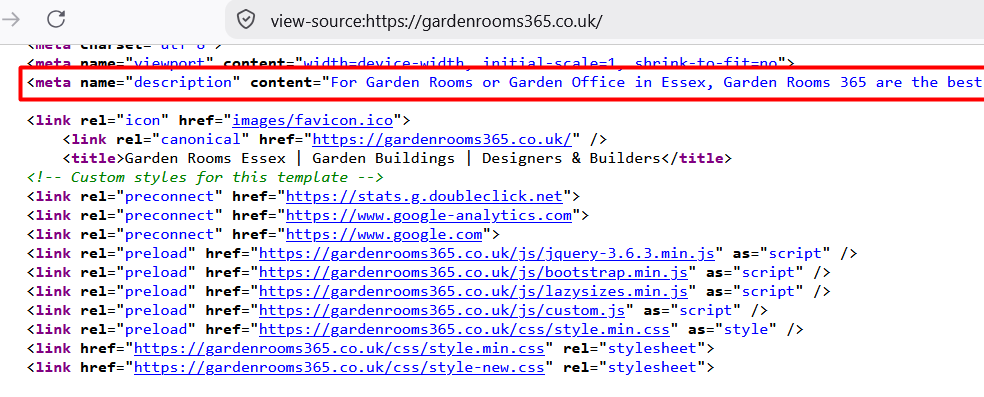
A strong meta description for a local garden room page does three things: confirms the location and service clearly, gives a genuine reason to choose you, and includes a soft call to action. Something like:
“Bespoke garden rooms built across Billericay and Essex. Fully insulated, built to last, with free no-obligation quotes. Get in touch today.”
That’s specific, it reinforces the location, and it nudges toward an action, rather than a vague line like “We build great garden rooms for all your needs.”
Keep Every Page Unique
One of the most common mistakes on garden room installer sites is duplicating the same title and meta description structure across multiple pages with barely any changes. Every page needs its own genuinely unique title and meta description, reflecting its own specific keyword and content. Google can identify duplicated or near-identical titles across a site fairly easily, and it does nothing to help either page stand out, in search results or against each other.
A Simple Way to Check Your Current Titles
Search your business name alongside a few of your core service and location terms, and take an honest look at what shows up. Is your homepage title clearly targeting your town and county? Do your local pages follow the keyword-plus-town structure? Are your service pages distinct from each other, or are they all competing with near-identical titles? This quick audit usually reveals exactly where the gaps are.
Bringing It All Together
Titles and meta descriptions are a small piece of a much bigger local SEO picture, but they’re one of the easiest to get right and one of the most commonly neglected. Target your main town and county together on the homepage, follow a consistent keyword-plus-town structure across your local pages, pair your service pages with the specific room type and your wider area, and write meta descriptions that genuinely sell the click rather than just describing the page. Get this right across every page on your site, and you’re giving both Google and your potential customers a much clearer reason to choose you.
If you want a proper audit of your current titles and meta descriptions, get in touch and we’ll show you exactly where the gaps are.