



How Installers Can Actually Win on Google
You didn’t get into the garden room trade to become an SEO expert. You got into it to build beautiful, functional spaces that people love spending time in. But here’s the reality of running a garden room business in 2026: if your website isn’t showing up when someone searches “garden room installer near me,” it doesn’t matter how good your builds are. You’re invisible to the exact people who want to buy from you.
SEO for garden rooms isn’t complicated in theory, but it does require doing a lot of small things properly, consistently, over time. There’s no shortcut, and there’s no single fix. What follows is a genuine breakdown of what it actually takes to rank — the same approach we use with our own garden room clients.
Start With Proper Keyword Mapping
Before you touch a single page on your website, you need to know exactly what people are typing into Google. Tools like Ubersuggest or SEMrush let you search a term like “garden rooms” alongside your town or county and see real search volume. As an example, “garden rooms Essex” gets searched around 720 times a month — that’s a keyword worth building a page around.
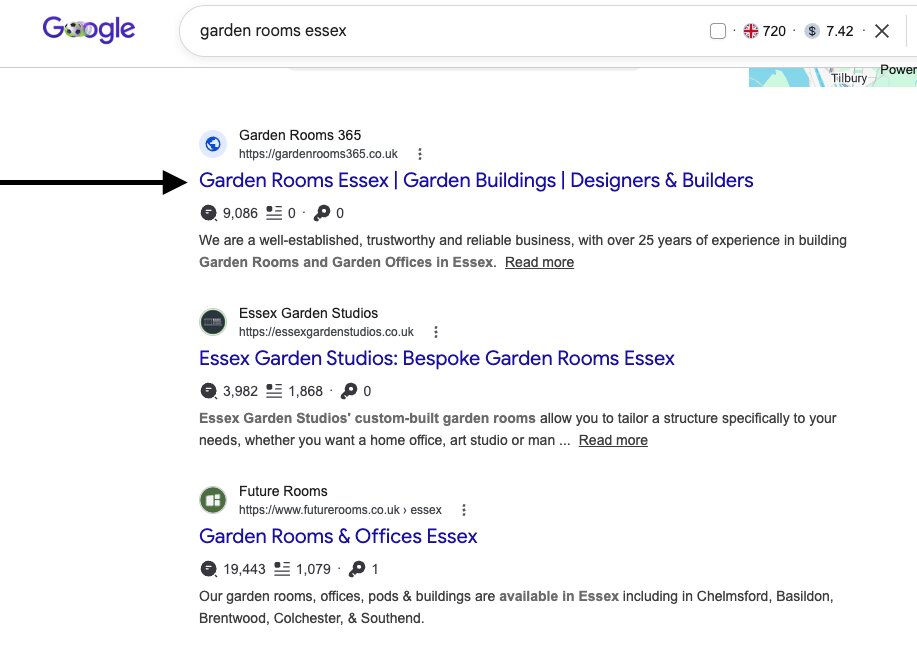
Put everything into a spreadsheet: the keyword, the monthly search volume, and which page on your site it’s going to target. Every page should have one clear primary keyword it’s built around. Trying to rank a single page for everything usually means it ranks for nothing. Check our blog on keyword research for garden rooms.
Get Your Title Tags and Meta Descriptions Right
Your title tag is one of the most important ranking factors on Google, and it’s also the first thing a potential customer sees on the search results page before they’ve even clicked through to your site. If it doesn’t include your keyword and, where relevant, your location, you’re leaving ranking power and click-through rate on the table. A location page for Billericay should have “Billericay” in the title — not just “Garden Rooms | Home.”
Fix Your Heading Structure
This is where a huge number of garden room websites quietly lose ranking potential.
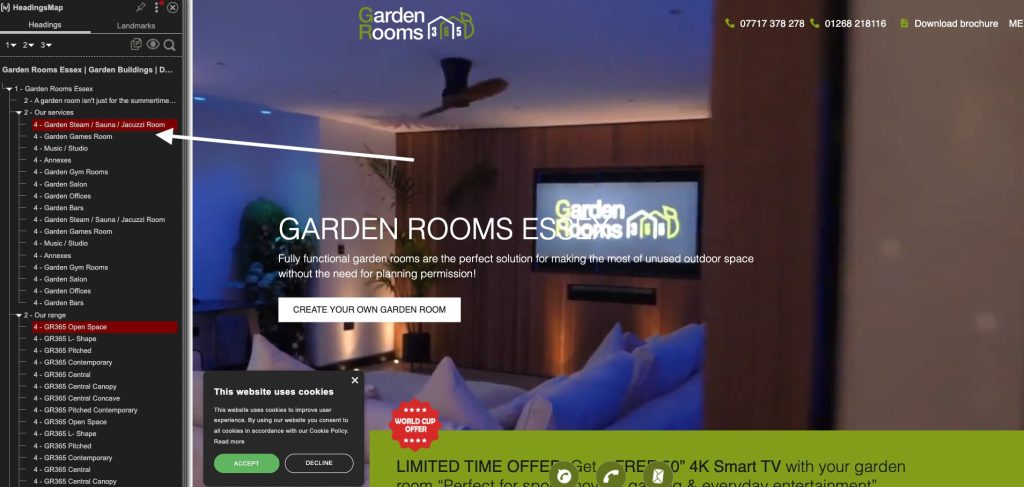
Every page needs one clear H1, followed by H2s and H3s that logically break the page down and, ideally, answer the actual questions your customers are asking. If you want to see exactly what structure your competitors are using, install a free Chrome extension like Heading Map — it’ll show you their H1s, H2s and H3s in seconds, and you can see straight away where your own pages are falling short.
Build Proper Location Pages
If you’re based in Essex, people aren’t just searching “garden rooms” — they’re searching by town too. Your homepage should be targeting your core area (something like “Garden Rooms Southend and All of Essex”), but to properly cover your wider service area, you need dedicated pages for each additional town: garden rooms Billericay, garden rooms Colchester, garden rooms Chelmsford and so on.
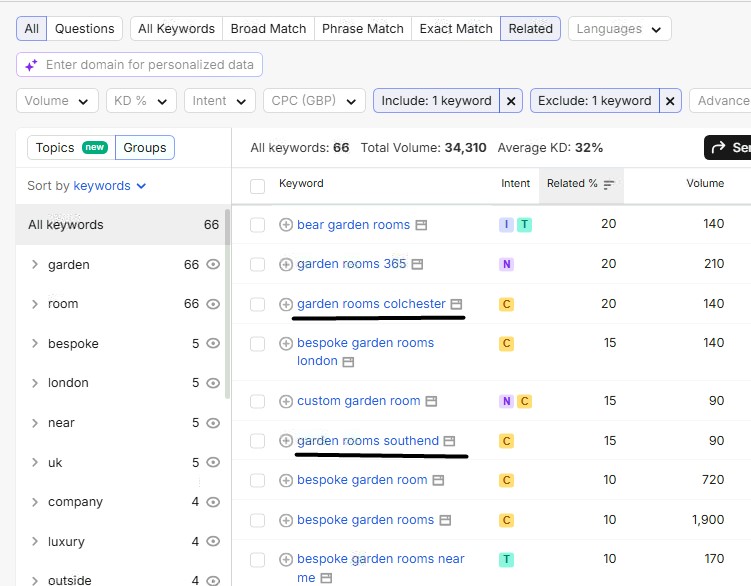
The key here is that these can’t be the same page with the town name swapped out — Google sees straight through that. Search the term yourself, look at whoever’s ranking top for that town right now, and build a page that’s genuinely better: better content, better photos, better detail on that specific area.
Separate Your Services Properly
Garden offices, garden gyms, garden bars, granny annexes — these all deserve their own dedicated page, not one crowded “products” page trying to cover everything at once. Each service page targets its own keyword, ranks on its own merit, and should sit clearly in your main navigation so both Google and your visitors can find it easily. Check how to do service page SEO.
Internal Linking Ties It All Together
Once you’ve got location pages and service pages built, they need to link to each other. Blog posts and service pages should link back to your quote and contact pages, and to relevant location pages, so authority flows through the site to the pages that actually matter for business — your enquiry pages. A dedicated coverage page that internally links out to every local service page is a simple way to tie your whole area coverage together in one place. Check more how to do internal linking.
Don’t Skip Schema Markup
LocalBusiness and Service schema markup helps Google understand exactly what your business is, what you offer, and where you operate. It’s a technical step, but it’s one of the clearer ways to help Google categorise your site correctly rather than guessing.
NAP Consistency and Citations
Your Name, Address, and Phone number need to be identical everywhere — every page of your website, and every directory listing you appear on. Start with the big free citations: Yell.com, Thomson Local, Hotfrog. Then move into niche-specific citations relevant to garden rooms, such as the Garden Room Directory, and location-specific directories for your area, like an Essex business map or a local city directory. Quality and consistency matter more than sheer volume here — a handful of clean, accurate, relevant citations does more for you than 50 messy, inconsistent ones.
Site Speed and Mobile Optimisation
Most people researching garden rooms are doing it on their phone, often in the evening. If your site is slow, you’re losing them before they even see your work. Run your website through GTmetrix — if the score’s poor, compress your images with TinyPNG and get a developer to look at what’s slowing things down. Speed isn’t just a ranking factor; it directly affects whether someone sticks around long enough to enquire.
Alt Tag Every Image
Every image on your site should have a proper alt tag, and on your location pages specifically, include the area in the alt text. It’s a small detail, but it adds up across a whole site’s worth of images.
Google Business Profile: Keep It Active
Your Google Business Profile deserves as much attention as your website. Use “Garden Building Supplier” as your main category and stick with just that one — adding a pile of extra categories tends to confuse Google about what you actually do, rather than helping.
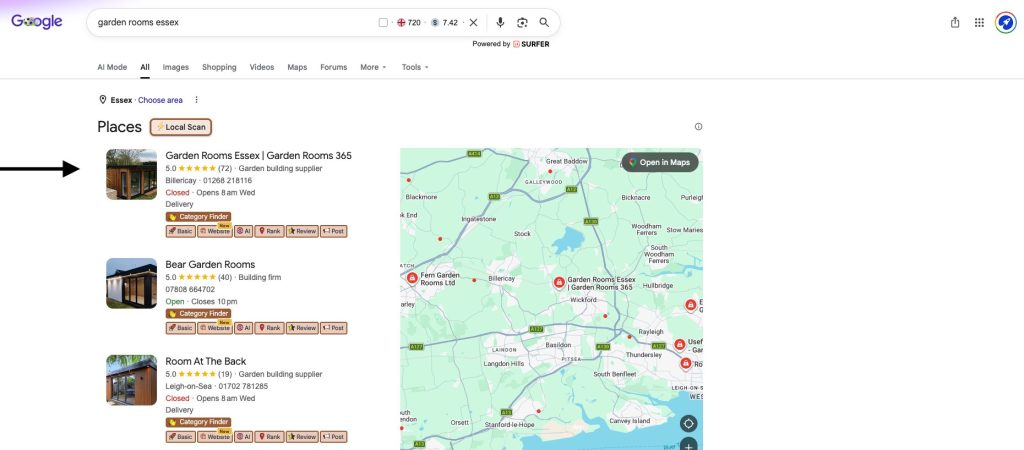
Photos matter enormously here. Upload finished products, not just the building process — people want to see the end result. If you’re showing before-and-after shots, label them clearly as a pair; nobody wants to scroll through a gallery of half-finished sheds with no payoff. Get in the habit of taking 50-plus photos of every completed job from different angles, so you’ve always got fresh content to post.
Post 2-3 times a week — offers, recent jobs, videos, testimonials — and keep the profile genuinely active. Respond to every review, positive or negative, and seed your Q&A section with the questions customers actually ask you. If you take bookings, link straight to a booking tool like Calendly rather than making people dig for your phone number.
Link Building That Actually Works
Reach out to home improvement, gardening, and construction blogs for guest posts or mentions — but make sure whatever you write is genuinely well structured and useful, not just a thinly veiled advert. When you link back to your own site, vary your anchor text rather than repeating the exact same phrase every time, and point different links to different relevant pages — “gym garden rooms” linking to your garden gym page, “office garden rooms” linking to your garden office page, and so on.
Local press coverage of a standout install, partnerships with complementary trades like landscapers or electricians, and links from suppliers or manufacturers you’re an approved installer for all add up to genuine authority over time. Check our blog on link building strategy.
Reviews and Reputation
Build a habit of requesting reviews systematically after every installation — Google, Trustpilot, Checkatrade, wherever your customers are likely to leave them. Respond to every single one professionally, and display your best reviews on-site near your calls to action, where they’ll actually influence someone about to enquire.
Content and Blogging
Search “garden rooms” on Google and look at the “People also ask” section — that’s a direct list of what people want answered. Questions like “Do I need planning permission for a garden room?” or “How much does a garden room cost in 2026?” make excellent blog posts because they capture people at exactly the research stage of their buying journey.
Tools like SEMrush can widen that list further, and blog content doesn’t have to be purely educational — new team members, recently completed jobs, and detailed case studies all make for genuine, engaging content too. Pair this with location-targeted posts supporting your area pages, and seasonal content like “the best time of year to install a garden room.” Check our blog on content strategy.
Track What’s Actually Working
None of this is worth much if you can’t measure it. Keep an eye on Google Search Console for indexing or ranking issues, set up call tracking so you know which channel is actually producing enquiries, and check your rankings for target keywords per location on a monthly basis. Without tracking, you’re optimising blind.
Bringing It All Together
SEO for garden room installers isn’t about chasing one trick or one algorithm update — it’s about consistently getting the fundamentals right across your website, your Google Business Profile, your citations, and your content, month after month. Done properly, it turns your website from a digital brochure into your best-performing salesperson.
If you’d rather have this built and managed properly than DIY it around the day job, get in touch and we can talk through exactly what this would look like for your business.