



Most tradespeople know reviews matter. What most don’t realise is that where those reviews sit matters just as much as how many you have — and having a system to collect them consistently is what separates the businesses that grow from the ones that stay stuck.
Here’s everything you need to know about getting more reviews, spreading them across the right platforms, and why it’s one of the most powerful things you can do for your trade business right now.
Why reviews are more important than ever for trades businesses

Before anyone picks up the phone to book a tradesperson, they check the reviews. Every time. It doesn’t matter how good your van looks, how slick your website is, or how many years you’ve been trading — if your reviews are thin or your score is low, they’re calling someone else.
Reviews are the digital version of word of mouth. And in the trades, word of mouth has always been everything. The difference now is that it happens publicly, online, and at scale. A happy customer leaving a five-star review isn’t just telling their neighbour — they’re telling everyone who searches for your trade in your area for the next five years.
The numbers speak for themselves. A trades business with 200 reviews will always win the call over one with 20 — even if the work is identical. People buy what other people buy. The more social proof you have, the more leads you get. It really is that simple.
Why you should spread your reviews across multiple platforms
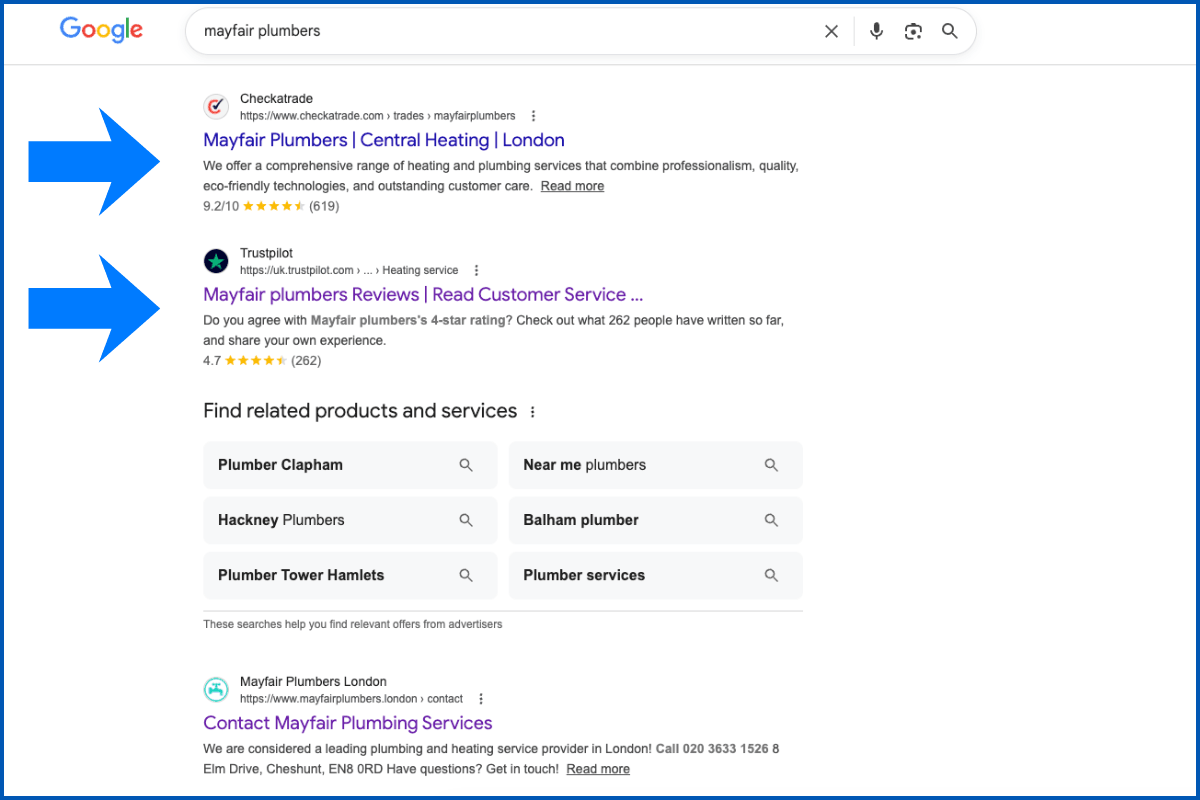
Here’s where most trades businesses get it wrong. They focus all of their energy on Google reviews — which is right to a point — but completely ignore every other platform. That’s leaving a lot on the table.
Google looks at your presence across multiple review platforms as a trust signal. A business with strong reviews on Google, Checkatrade, Trustpilot, and Facebook looks far more established and credible than one that only has Google reviews. And Google rewards that credibility with higher rankings in local search.
Then there’s AI. Tools like ChatGPT, Google AI, and other AI assistants are increasingly being used to find and recommend local service businesses. When someone asks “who’s the best plumber in Chelmsford?” these tools pull data from multiple platforms to generate a recommendation. If you only exist on one platform, you’re invisible to a growing chunk of potential customers searching that way.
Follow the 80/20 rule for reviews
You might have heard of the Pareto Principle — the idea that 80% of your results come from 20% of your efforts. It applies here too, and it’s the simplest framework you can follow for building your review presence the right way.
Put 80% of your review effort into Google Business Profile. That’s your primary platform and the one that has the biggest direct impact on your local search rankings, your Google Maps visibility, and your Local Service Ads performance. This is where the majority of your potential customers are looking and where a strong review score does the most work for your business.
The remaining 20% should be spread across other platforms — Checkatrade, Trustpilot, Facebook, and any other relevant directories. This builds your credibility everywhere your customers are looking, strengthens your overall online presence, and makes sure you’re getting picked up by AI tools that are pulling recommendations from across the web.
80% Google. 20% everywhere else. Simple, effective, and easy to follow consistently.
The platforms you should be getting reviews on
Google Business Profile is the non-negotiable. Reviews here directly impact where you appear in local search results and on Google Maps. This is where 80% of your effort goes.
Checkatrade is enormous in the trades. It ranks on the first page of Google for most trade searches across the UK and homeowners actively use it to find and vet tradespeople. Being well reviewed here puts you in front of a warm, ready-to-buy audience.
Trustpilot is one of the most widely recognised review platforms among consumers. A strong Trustpilot score adds instant credibility — particularly when it’s displayed on your website alongside your Google reviews.
Facebook reviews get seen by local community groups and shared audiences. Someone asking for a recommendation in a local Facebook group and seeing your business come up with strong reviews is one of the warmest referrals you can get.
Review velocity — why consistency matters as much as volume

This is something most businesses never think about — and it’s costing them without them even realising it.
We’ve seen trades businesses with 150, even 200 reviews completely stall on Google because they haven’t received a single new review in six months. And here’s the thing — Google notices. A long gap in reviews sends a signal that either the business has slowed down, customers aren’t happy, or worse, the company is no longer active. None of those signals are good for your rankings.
Google doesn’t just want to see that you’ve been good in the past. It wants to know that people are having a good experience with your business right now. Review velocity — the rate at which new reviews come in — is a factor in how prominently Google shows your business in local search results.
It directly affects two things in particular. First, your Google Business Profile ranking. Businesses that collect reviews consistently tend to rank higher and maintain that ranking over time. Second, your Local Service Ads performance. We’ve seen Local Service Ad accounts with strong review scores drop off significantly simply because new reviews dried up. Google uses recent review activity to decide how prominently to show your listing — and if that activity stops, your visibility drops with it.
The sweet spot we’ve found for most trade businesses is one to two new reviews per week. That’s enough to show Google consistent activity, keep your score climbing, and stay ahead of competitors who are collecting reviews sporadically. It doesn’t sound like much — but maintained over twelve months, that’s 50 to 100 new reviews a year building on top of what you already have.
Volume matters. But velocity matters just as much.
Why most trades businesses struggle to get reviews
The job gets done. The customer is happy. And then nothing happens.
This is the most common pattern we see. The problem isn’t that customers don’t want to leave reviews — most of them genuinely intend to. The problem is that life gets in the way, the moment passes, and without a prompt they just forget.
Asking face to face feels awkward for a lot of tradespeople. Sending a link over text gets ignored more often than not. And without a proper system in place, reviews trickle in sporadically and never build real momentum.
The businesses collecting reviews consistently aren’t doing anything magical. They just have a process — and they follow it every single time.
How to get more reviews — practical tips that actually work

Print a QR code on your business cards. Link it directly to your Google review page. Hand one to every customer at the end of every job. It takes two seconds and removes every barrier between the customer and leaving a review. They scan, they tap, they type. Done.
Ask at the right moment. The best time to ask for a review is right after the job is finished, when the customer is standing there looking at the result and feeling good about it. That’s peak satisfaction — and peak satisfaction is when people are most likely to say yes.
Make it as easy as possible. The fewer steps between the customer and the review page the better. A direct link, a QR code, or a follow-up message with a single tap to review — remove every possible reason for them to put it off.
Follow up. Most people mean to leave a review but forget within 24 hours. A polite follow-up message a few days later — “just checking you were happy with everything, it would mean a lot if you had a moment to leave us a review” — recovers a huge number of reviews that would otherwise never happen.
The smarter way to get reviews on autopilot
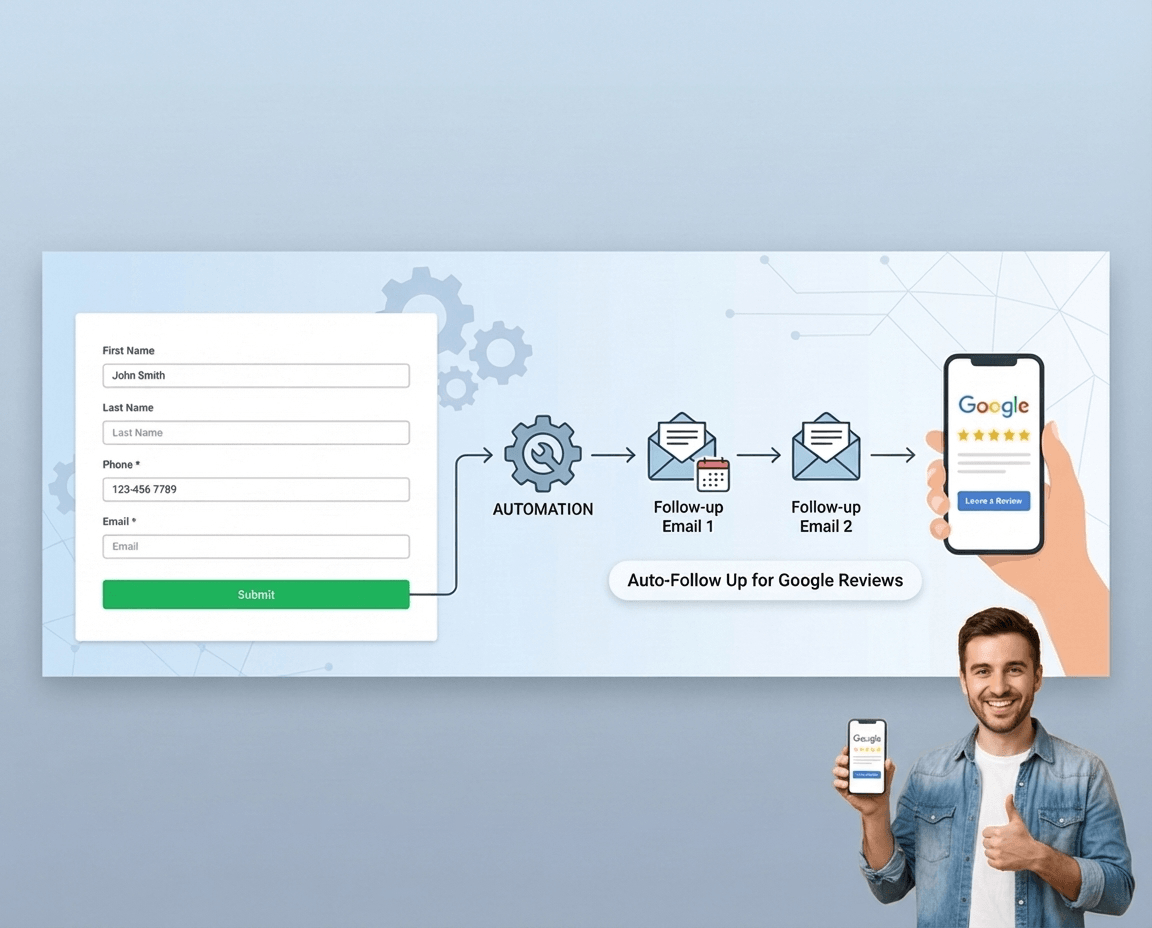
Doing all of the above manually is better than nothing. But there’s a smarter way — and we’ve built it specifically for trade businesses.
We’ve created a dedicated review follow-up system that takes the whole process off your plate. Here’s how it works.
You get a simple webpage that you bookmark on your phone. At the end of every job, you put in the customer’s name, phone number, and email address. That’s it — thirty seconds of your time.
The system instantly sends them a message. If you’re still with the customer when you do it, you can walk them through leaving a review there and then while the job is fresh in their mind. That’s the highest-converting moment you’ll ever get.
If the customer doesn’t have time right then, or they don’t respond to the first message, the system automatically follows them up every week for four weeks. Polite, consistent, and completely hands off. You don’t have to think about it, chase anyone, or remember who you’ve asked. The system does it all.
The result is a steady, consistent flow of reviews coming in every month across the platforms that matter — without you having to lift a finger after that initial thirty seconds. Review velocity maintained. Google rankings protected. Local Service Ads performing. All on autopilot.
Start building your review strategy today
Reviews aren’t nice to have — they’re one of the most important lead generation tools your trade business has. Get them on the right platforms, collect them consistently, and you’ll start to see the impact on your Google rankings, your AI visibility, and the number of calls coming in.
Follow the 80/20 rule. Maintain your review velocity. Have a system. And never let a happy customer walk away without turning that satisfaction into social proof that works for your business long after the job is done.
If you want to find out more about our review follow-up system and how it can work for your trade business, get in touch today.